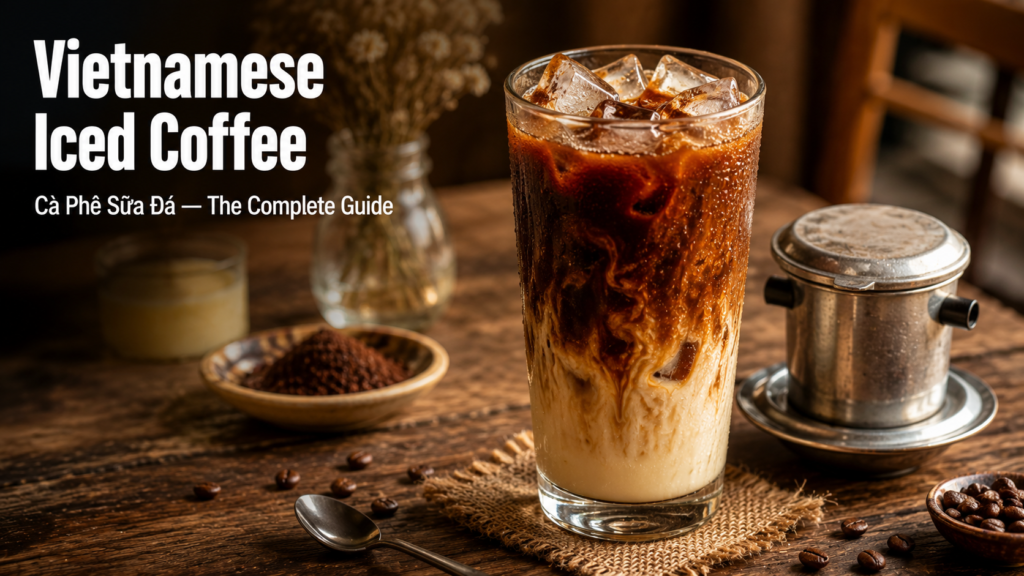
Vietnamese iced coffee (cà phê sữa đá) is a bold, sweet coffee drink made by slowly dripping strong dark-roast Vietnamese coffee through a metal phin filter over a layer of sweetened condensed milk, then stirring and pouring it over ice. Brewed from robusta beans, it’s richer and stronger than most Western coffee.
Vietnamese coffee at a glance
- Vietnamese name: Cà phê sữa đá (coffee + milk + ice)
- Pronunciation: roughly “kah-fey soo-uh dah”
- Beans: Dark-roast robusta — stronger and more bitter than arabica
- Brewing: A small metal drip filter called a phin
- Sweetener: Sweetened condensed milk
- Caffeine: Strong — often more than a regular cup of coffee
What is Vietnamese iced coffee?
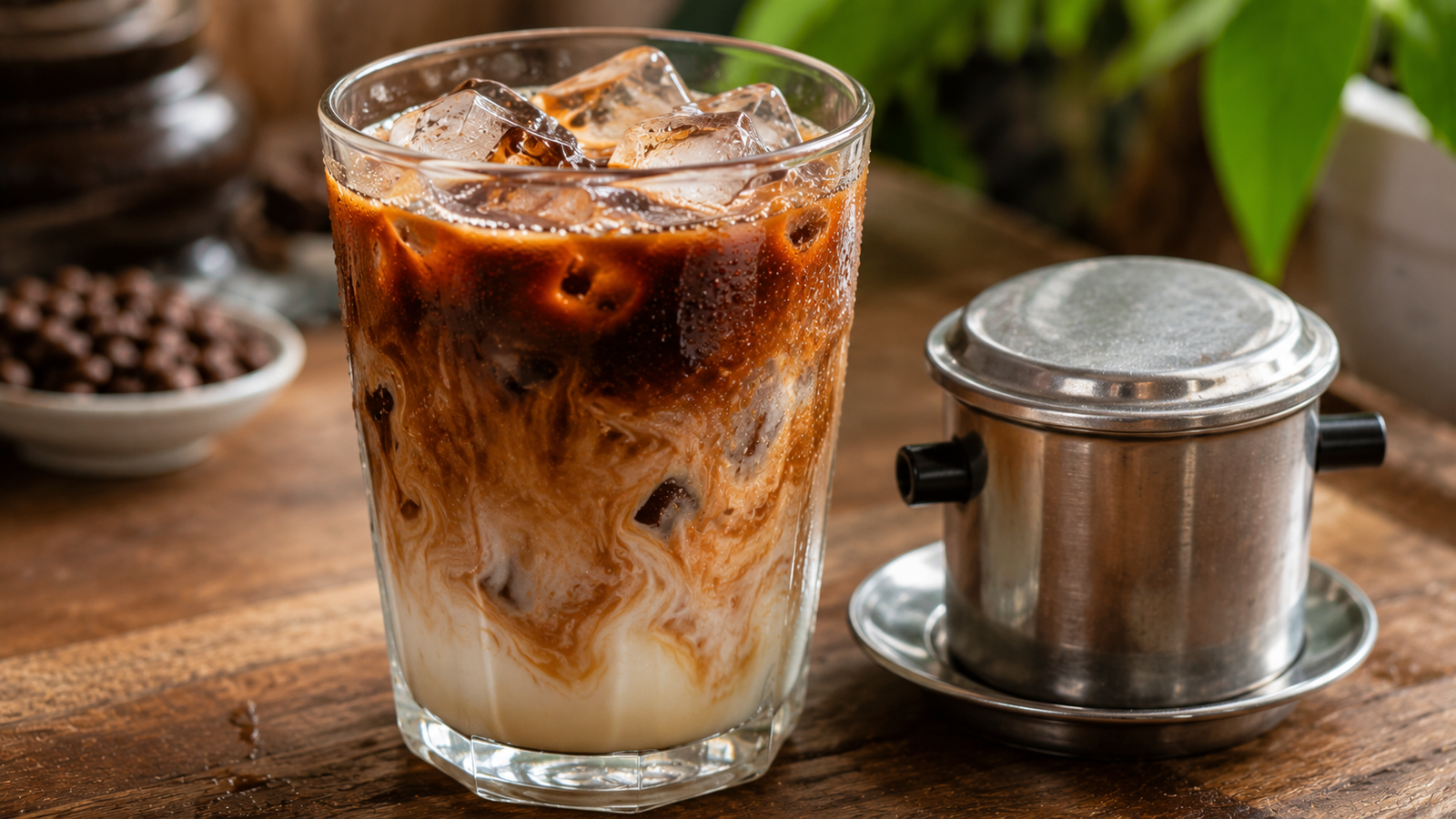
Vietnamese iced coffee is Vietnam’s signature coffee drink: intense, sweet, and impossibly smooth. A spoonful of sweetened condensed milk goes in the bottom of the glass, and strong coffee drips onto it from a phin filter perched on top. You stir the two together until the milk dissolves into a caramel-colored brew, then pour it over ice.
The result is a coffee that’s simultaneously bold and dessert-like — the bitterness of dark robusta balanced by the creamy sweetness of condensed milk. It’s the perfect antidote to a hot day, which is exactly how it became a fixture on every street corner in Vietnam.
How do you pronounce “ca phe sua da”?
Cà phê sữa đá is pronounced roughly “kah-fey soo-uh dah.” Broken down: cà phê means coffee (“kah-fey”), sữa means milk (“soo-uh”), and đá means ice (“dah”). Put together, it simply means “iced milk coffee.” See our pronunciation guide for more.
What does Vietnamese coffee taste like?
Vietnamese coffee tastes deep, dark, and chocolatey, with a heavy body and a bittersweet finish. The robusta beans give it an almost cocoa-like intensity that arabica can’t match, while the condensed milk rounds it out with rich, creamy sweetness. It’s strong without being harsh — and far sweeter than a typical American iced coffee.
How is Vietnamese coffee made?
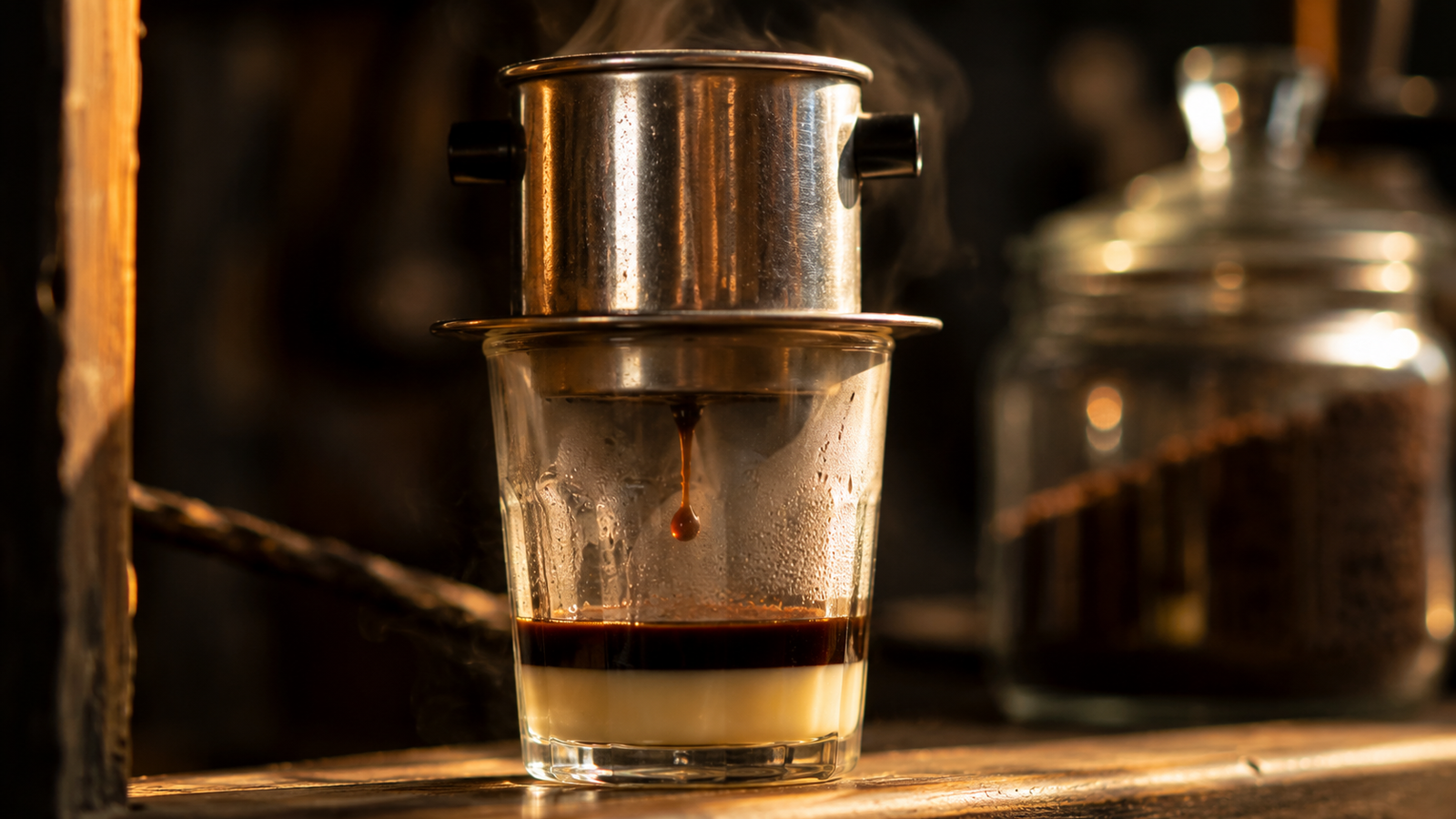
The classic method uses a phin — a small metal filter that sits on top of your glass:
- Add 2–3 teaspoons of sweetened condensed milk to the glass.
- Place the phin on top, add coarsely ground dark-roast coffee, and gently tamp it.
- Pour a little hot water to “bloom,” then fill the phin and let it drip slowly (3–5 minutes).
- Stir the coffee and condensed milk together until smooth.
- Pour over a glass of ice — and enjoy.
For the full method and tips, see how to make Vietnamese coffee with a phin filter.
Why is Vietnamese coffee so strong?
The secret is the bean. Vietnam is the world’s largest producer of robusta coffee, which contains roughly twice the caffeine of arabica — the bean used in most Western coffee. Combined with a dark roast and a slow, concentrated phin drip, that makes Vietnamese coffee notably strong. For exact numbers, read how much caffeine is in Vietnamese coffee.
Types of Vietnamese coffee
Cà phê sữa đá is the most famous, but there’s a whole family of Vietnamese coffee drinks worth knowing:

| Vietnamese name | What it is |
|---|---|
| Cà phê sữa đá | Iced coffee with sweetened condensed milk — the classic |
| Cà phê đen đá | Black iced coffee, no milk (often lightly sweetened) |
| Cà phê sữa nóng | Hot coffee with condensed milk |
| Bạc xỉu | Milkier and lighter — more condensed milk, less coffee |
| Cà phê trứng | Egg coffee — whipped egg yolk and condensed milk over coffee (a Hanoi specialty) |
| Cà phê dừa | Coconut coffee — blended with creamy coconut |
Two favorites have their own guides: Vietnamese egg coffee and coconut coffee.
Vietnamese coffee vs regular coffee
The biggest differences come down to the bean and the sweetener. Vietnamese coffee uses dark-roast robusta — stronger, more bitter, and higher in caffeine — and is sweetened with condensed milk rather than sugar and cream. Western coffee usually leans on milder arabica. See the full comparison in Vietnamese coffee vs regular coffee.
A brief history of Vietnamese coffee
The French introduced coffee to Vietnam in the mid-19th century. Because fresh milk was scarce and didn’t keep well in the tropical climate, locals reached for shelf-stable sweetened condensed milk instead — and a national drink was born. Robusta thrived in Vietnam’s Central Highlands, and today the country is one of the world’s top coffee exporters. Vietnamese coffee culture later traveled with the diaspora to the United States, where cà phê sữa đá is now a café staple.
Find Vietnamese coffee near you ☕
Discover authentic Vietnamese cafés and restaurants serving cà phê sữa đá across all 50 US states.
Find Vietnamese Coffee Near Me →Frequently asked questions about Vietnamese coffee
What is ca phe sua da?
Cà phê sữa đá is Vietnamese iced coffee made with strong dark-roast coffee dripped over sweetened condensed milk and poured over ice. The name literally means “coffee milk ice.”
How do you pronounce ca phe sua da?
It’s pronounced roughly “kah-fey soo-uh dah.” Cà phê means coffee, sữa means milk, and đá means ice.
Why is Vietnamese coffee so strong?
Vietnamese coffee is made from robusta beans, which contain about twice the caffeine of the arabica beans used in most Western coffee. A dark roast and a slow, concentrated phin drip make it even stronger.
What kind of milk is in Vietnamese coffee?
Sweetened condensed milk. It was originally used because fresh milk was hard to keep in Vietnam’s tropical climate, and it gives the drink its signature creamy sweetness.
How is Vietnamese coffee brewed?
It’s brewed with a phin, a small metal drip filter that sits on top of the glass. Hot water passes slowly through the grounds and drips onto a layer of condensed milk below.
How much caffeine is in Vietnamese coffee?
Because it uses robusta beans, a serving is strong — typically more caffeine than a regular cup of coffee. The exact amount depends on the coffee-to-water ratio and serving size.
Exploring Vietnamese cuisine? Browse our full Vietnamese food guide for more must-try dishes and drinks.